portfolio

selected work

what i worked on, or built from scratch, and little stories and numbers about it

Filter
Year2024 → present
Rolefounder · sole engineer
DomainAI · Audio · Backend
StatusLive · Android & web · iOS next

/case study 01

musairec

a recorder that understands your song ideas and helps you develop them
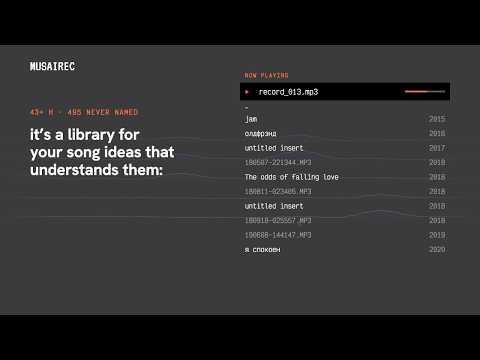
Musairec · Product demo · 2026

Background

When I got into songwriting, I recorded my long jams on an old Nokia, but the next day I often couldn't play my favourite takes on the guitar, because I'm that bad at picking out chords and notes by ear. Finding a specific take in a long unnamed list was next to impossible too, so the ideas mostly stayed as recordings, lost in space for decades...

I started coding in 2012 and tried to fix it with an Android app where I'd type in the tabs and chords manually, but writing things in after a jam is a chore unless it's automatic, so the idea was dropped. By 2022 the technology had learned to transcribe music to MIDI and to continue or accompany it, so I started prototyping around 2023 and founded Musairec in 2024.

What I built

Musairec brings new recordings and imported takes into one library, transcribes them into notes, chords, key, tempo and tabs, and tags each take by instrument, so any idea can be found by its musical information. Stems split a take into parts, and suggestions continue or accompany what you played as editable MIDI that can be layered part by part and exported into a DAW.

One Flutter codebase for Android, iOS and web, with the backend in Node.js and Python on GCP.

  • Ported the transcription and instrument-tagging models to run locally on the phone and in the browser.
  • Checked the transcription port against the original model's own tests, so it hears the music the same way.
  • Stems and suggestions are too heavy for a phone or a browser, so they run on cloud GPU services that scale to zero.
  • Offline-first sync with per-property conflict resolution, so two devices editing the same recording don't overwrite each other.
  • One billing service for Google Play, the App Store and Stripe on the web.

Recognition

1 of 10 startups selected by Barcelona Music Lab for the 2024 pitch session at Mercat de Música Viva de Vic (MMVV, September 2024). Selected for the SoAlive Startup Showcase 2026, run by Amplitude Ventures in Sofia (October 2026). Member project of the Barcelona Music Tech Hub.

Looking back

Scope smaller and plan first based on business needs and the MVP. I spent too much time on resilience, edge cases and new features before shipping the core loop. The details matter to musicians, but some of them could have waited until after launch.

Year2020 — 2026
RoleVolunteer → Lead Engineer
DomainPublic health · Mobile · Backend
StatusDeployed for Arizona & Bermuda

/case study 02

Covid Watch → WeHealth → Hub Public Benefit Corp

Open-source digital contact-tracing project. One of the first GAEN pilots in the US. Deployed for Arizona and Bermuda.

Covid Watch / WeHealth / Hub Public Benefit Corp · 2020 — 2026

Background

In March 2020, amid the COVID-19 pandemic and isolation measures, I joined an open-source project called Covid Watch for digital contact tracing as a volunteer to lead the Android development team.

Later, Google and Apple shipped the Exposure Notification API (GAEN), inspired by Covid Watch's TCN protocol, and access to it was only granted to government-backed apps. The nonprofit wound down; the work continued inside WeHealth, a newly formed public benefit corporation, and I went from volunteer to employee.

What I did

During the open-source days, I led development of the BLE contact-tracing Android SDK. When GAEN landed, I drove the Android move from our TCN protocol to Apple and Google's Exposure Notification API, including Flutter packages for GAEN written during the 2021 cross-platform migration. At WeHealth I took over deployment and maintenance of Google's open-source Exposure Notifications Server (Go) on our GCP infrastructure, maintained the fork, and contributed upstream fixes.

Covid Watch was one of the first apps on the Exposure Notification API in the US, in testing at the University of Arizona from June 2020. It later ran as the official statewide app for Arizona, after the security review the Arizona Department of Health Services required before it would sign, and in production for the Government of Bermuda.

From 2021 the platform grew past contact tracing into public-health and hazard alerting for the whole US, as PHapp and Wehealth Notify.

  • Migrated the native iOS and Android apps to Flutter (100K+ installs on Google Play alone) and shipped both as web apps.
  • Built the internationalisation behind its 50+ languages.
  • Built the alerting pipeline that ingests NWS and CDC feeds: 3.3M alerts to 3,432 communities in 2025.
  • Owned the GCP backend, API services, schedulers, monitoring and cost.
  • Built MCP servers so external users can reach the platform from AI assistants.

Notes

I started as an Android developer only and then gradually took on more responsibilities as technical demand grew and as a result I learned more about the backend, infrastructure, and cloud services to make it all work. By 2022, with the team down to three, I owned mobile, backend, and infrastructure.

Year2016 — 2018
RoleSole Android developer
DomainMobile · AR / CV
StatusShipped · Kickstarter-funded

/case study 03

Slice Planner

Hybrid paper-digital planner by Evopaper. The phone camera reads a clock-face diagram from the notebook, OCRs handwritten events, and overlays calendar conflicts back onto the page. Kickstarter-funded: $117,522 from 3,118 backers in late 2016.

Slice Planner · Android + iOS · 2016 — 2018

Background

Evopaper designed a notebook with a 12-hour clock-face diagram on every left page, and a software promise: point your phone at the paper and the app reads handwritten plans, syncs them to your calendars, and overlays scheduling conflicts directly on the page. The product was Kickstarter-bound on a fixed timeline.

What I built

Built the Android app from scratch, porting what already existed on iOS: augmented-reality features with OpenCV, OCR, and calendar sync.

Notes

I had strong Android and no OpenCV background when I took the role, and learned it on the job.

Year2016
RoleAndroid developer · Zizmos
DomainMobile · Signal processing
StatusShipped

/case study 04

eQuake

Earthquake early-warning app by Zizmos. Phones on charge act as seismic sensors; the network detects events and pushes alerts before shaking arrives.

eQuake · Zizmos · Android · 2016

Background

Zizmos built a crowdsourced earthquake early-warning network. eQuake turned Android phones into seismic sensors when plugged in and on Wi‑Fi, streamed accelerometer data to Zizmos servers, and pushed alerts seconds before shaking reached the user. The app also pulled USGS earthquake feeds, ran an alert simulator on historical quakes nearby, and needed a live visualization so users could see what their phone was sensing.

What I built

Joined as an Android developer for six months in 2016. The main deliverable was the real-time accelerometer graph users see in sensor mode. It had to render smoothly on high-end hardware and stay usable on low-end devices, so I built tiered rendering settings into the visualization. I also integrated the earthquake-detection algorithm into the Android sensor pipeline and did the accelerometer data-path work around it.

Year2019 — 2020
RoleMSc thesis · UPF
DomainResearch · MIR
StatusPublished · Zenodo

/case study 05

Zero-shot singing voice conversion

Adapting AutoVC, a zero-shot speech voice conversion model, to singing: converting a singer's timbre into a target voice the model never saw during training.

MSc thesis · UPF Barcelona · 2020

Background

Singing voice conversion transforms one singer's voice into another's while keeping the lyrics, melody and rhythm. Voice conversion was well studied for speech but barely explored for singing, where pitch and timing are fixed by a musical score and speech-only methods don't transfer.

The harder case is zero-shot: converting to a target voice from a short reference clip, with no retraining per singer, which at the time hadn't been published for singing. MSc thesis at UPF Barcelona (Sound & Music Computing), supervised by Pritish Chandna and Jordi Bonada.

What I built

I adapted AutoVC, a zero-shot speech conversion model, to singing. The system converts timbre only and keeps the source singer's melody and expression: it encodes the target voice as a neural embedding, separates content from speaker identity through an autoencoder bottleneck, and re-synthesizes using WORLD features with the source pitch fed in directly so the melody is preserved.

The core question was which speaker-embedding model works best for singing. I compared GE2E (trained on 8.4k speakers of speech) against JE (trained on 1,000 singers for singer identification), plus a one-hot baseline with no zero-shot capability. Trained and evaluated on the NUS, JVS, and a proprietary 46-singer dataset, with code and audio demos published.

Notes

The question was whether speech methods could be adapted to singing at all; quality came second. The surprise was GE2E. Trained only on speech, it generalized to singing and scored best in the listening tests on timbre, melody, language and audio quality. Architecture mattered more than how much data the model had seen. The WORLD vocoder was the ceiling on audio quality.

Year2018
RoleWolfram Summer School · ML
DomainMusic generation
StatusWrite-up · Wolfram Community (Staff Pick)

/case study 06

Generating dynamic piano performances

A recreation of Magenta's Performance RNN in Wolfram Language: an RNN that learns expressive timing and dynamics for solo piano from MIDI performances.

Wolfram Summer School · ML track · 2018

Background

A reimplementation of the Magenta team's Performance RNN, built during Wolfram Summer School 2018. The goal was to generate music with loudness dynamics and human-like timing, learned from MIDI performances.

What I built

An RNN trained on solo-piano performances from the Yamaha e-Piano Competition (MIDI), encoded as a stream of ~310 note-on, note-off, time-shift, and velocity events, the same representation Magenta used. The network was adapted from Wolfram's character-level language model and trained with teacher forcing. Data prep, training, and MIDI playback all lived in one notebook.

Notes

The model started overfitting after 10–15 of 30 training rounds and I wasn't satisfied with the output. Smaller GRU layers and putting the dropout layer back would probably have helped; I ran out of time. Having the whole pipeline in one Wolfram notebook did make it fast to iterate on the data and the loss.

/get in touch

Open to work and collaborations.

Get in touch